> For the complete documentation index, see [llms.txt](https://docs.quanti.io/llms.txt). Markdown versions of documentation pages are available by appending `.md` to page URLs; this page is available as [Markdown](https://docs.quanti.io/connectors/analytics-connectors/matomo.md).
# Matomo
Follow our setup guide to connect your Matomo connector with QUANTI:
Prebuilt reports and definition
***
## Prerequisites
To connect Matomo to QUANTI:, you need a [Matomo](https://fr.matomo.org/login/) account.
***
## Setup instructions
### Find your Auth token
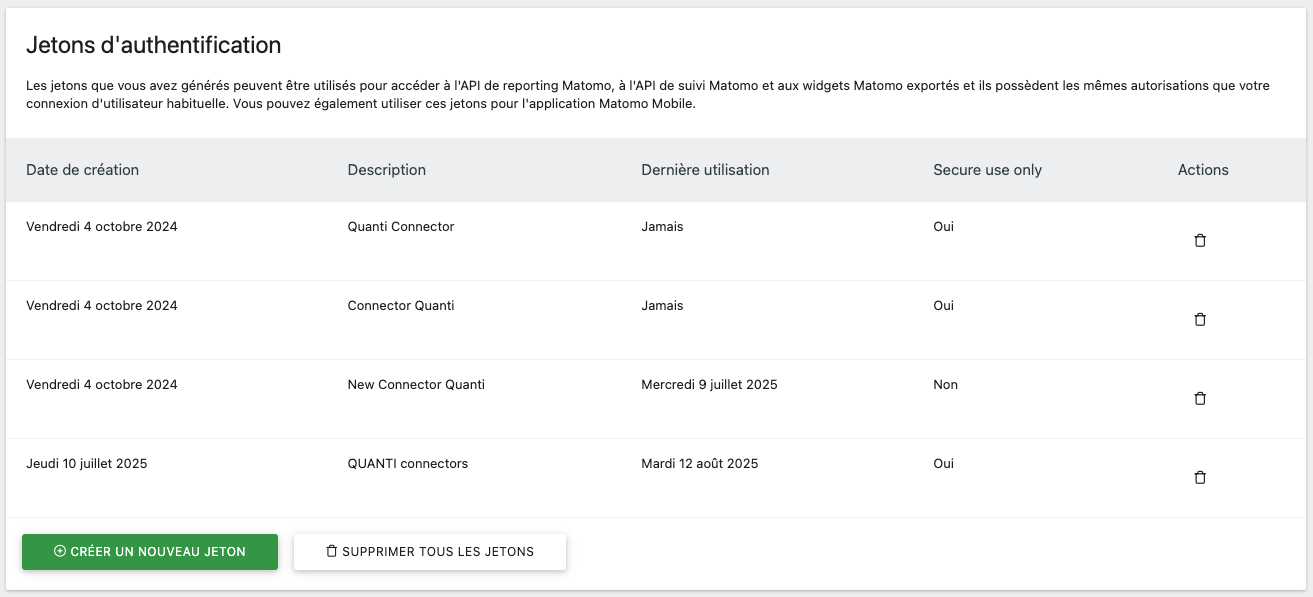
1. Go to Matomo settings Settings Cog Icon > Personal > Security.
2. At the bottom of the page, click on Create new token.
3. Confirm your account password.
4. Enter the purpose for this token.
5. Choose if the token should only be valid for secure requests (Matomo 5 and newer).
6. Click on Create new token.
### Connector configuration
1. Authentication
1. Enter the Auth token you retrieved in the previous step.
2. Enter the Matomo URL that allows you to access your reports. This should be in the form: .
2. Connector information
1. Connector Name: Name your connector. It must be unique.
2. Dataset ID: Define the ID of the dataset. It must not already exist, as it will be created and data will be sent there.
3. Select your Advertiser Id: Choose your Advertiser ID.
4. Select the pre-built reports you want to synchronize, and/or create your own custom reports. To help you configure custom reports, refer to the **Custom reports** chapter below.
***
## Prebuilt reports
### Visitor
**visitor\_country**: Website visits, user actions and conversions segmented by the visitor's country. Dimensions: date, country. Metrics: visits, users, actions, bounces, conversions, converted\_visits, total\_visit\_length, revenue.
**visitor\_device\_type**: Website activity broken down by device type (desktop, mobile, tablet). Dimensions: date, device\_type. Metrics: visits, users, actions, bounces, conversions, converted\_visits, total\_visit\_length, revenue.
**visitor\_language**: Engagement metrics segmented by the visitor's browser language. Dimensions: date, language. Metrics: visits, users, actions, bounces, converted\_visits, total\_visit\_length, revenue.
***
### Behaviour
**behaviour\_page**: Page-level engagement — entrances, exits, pageviews and time spent per URL. Dimensions: date, page\_title, page\_url. Metrics: pageviews, entrances, entry\_actions, entry\_bounces, exits, total\_time\_spent, visits\_following\_search.
**behaviour\_event**: Event tracking by category — event counts, unique events and total/average event value. Dimensions: date, event\_category. Metrics: events, unique\_events, event\_value\_sum, event\_value\_avg.
***
### Acquisition
**acquisition\_campaign**: Visitor metrics grouped by marketing campaign name. Dimensions: date, campaign\_name. Metrics: visits, users, actions, bounces, conversions, converted\_visits, total\_visit\_length, revenue.
**acquisition\_channel\_type**: Website performance aggregated by high-level marketing channel (organic, paid, social, direct…). Dimensions: date, channel\_type. Metrics: visits, users, actions, bounces, conversions, converted\_visits, total\_visit\_length, revenue.
**acquisition\_referrer**: Visits and conversions by referring source, type and URL. Dimensions: date, referrer, referrer\_type. Metrics: visits, users, actions, bounces, conversions, converted\_visits, total\_visit\_length, revenue.
***
```mermaid
erDiagram
visitor_country {
DATE _quanti_date PK
STRING country PK
DATE date
INTEGER visits
INTEGER users
INTEGER actions
INTEGER bounces
INTEGER conversions
FLOAT revenue
STRING website_id
}
visitor_device_type {
DATE _quanti_date PK
STRING device_type PK
DATE date
INTEGER visits
INTEGER users
INTEGER actions
INTEGER bounces
INTEGER conversions
FLOAT revenue
STRING website_id
}
visitor_language {
DATE _quanti_date PK
STRING language PK
DATE date
INTEGER visits
INTEGER users
INTEGER actions
INTEGER bounces
FLOAT revenue
STRING website_id
}
behaviour_page {
DATE _quanti_date PK
STRING page_title PK
STRING page_url PK
DATE date
INTEGER pageviews
INTEGER entrances
INTEGER exits
INTEGER total_time_spent
STRING website_id
}
behaviour_event {
DATE _quanti_date PK
STRING event_category PK
DATE date
INTEGER events
INTEGER unique_events
FLOAT event_value_sum
FLOAT event_value_avg
STRING website_id
}
acquisition_campaign {
DATE _quanti_date PK
STRING campaign_name PK
DATE date
INTEGER visits
INTEGER users
INTEGER conversions
FLOAT revenue
STRING website_id
}
acquisition_channel_type {
DATE _quanti_date PK
STRING channel_type PK
DATE date
INTEGER visits
INTEGER users
INTEGER conversions
FLOAT revenue
STRING website_id
}
acquisition_referrer {
DATE _quanti_date PK
STRING referrer PK
STRING referrer_type PK
DATE date
INTEGER visits
INTEGER users
INTEGER conversions
FLOAT revenue
STRING website_id
}
```
***
Prebuilt reports and definition
***
## Custom reports
Matomo custom reports let you query any endpoint of the [Matomo Reporting API](https://developer.matomo.org/api-reference/reporting-api) and bring the result directly into your data warehouse.
#### Find available methods and fields
Each custom report is built around a **Matomo API method** (e.g. `VisitsSummary.get`, `Events.getCategory`). The method determines which fields are returned.
The reference for all available methods and their fields is the official Matomo Reporting API documentation: 👉 [developer.matomo.org/api-reference/reporting-api](https://developer.matomo.org/api-reference/reporting-api)
{% hint style="info" %}
**Use an AI assistant to speed up the configuration.** Rather than browsing the full API reference manually, describe the report you want to reproduce — as you see it in the Matomo interface — to an AI assistant (Claude, ChatGPT…). For example:
> *"I want to build a custom Matomo report showing event categories with the number of events and their total value. What API method and fields should I use in the QUANTI JSON format `{ "report": "", "flat": "1", "fields": "" }` ?"*
The AI will identify the correct `report` value and the exact `fields` string for you.
{% endhint %}
#### Configure the custom report
In QUANTI, at the **Select pre-built reports** step, click **Add custom report**. Fill in the following JSON:
```json
{
"report": "",
"flat": "1",
"fields": ""
}
```
* **`report`** *(required)*: The Matomo API method name (e.g. `"VisitsSummary.get"`, `"Events.getCategory"`)
* **`flat`**: Set to `"1"` to flatten nested JSON structures — recommended for most reports
* **`fields`** *(optional)*: Comma-separated list of field names to retrieve. If omitted, all fields returned by the method are ingested — useful for a first run to discover what arrives in BigQuery
#### Common report examples
| Report | `report` value | Key `fields` |
| ---------------- | --------------------------- | -------------------------------------------------------------------- |
| Visit summary | `VisitsSummary.get` | `nb_visits,nb_uniq_visitors,nb_actions,bounce_rate,avg_time_on_site` |
| Event categories | `Events.getCategory` | `label,nb_events,sum_event_value,avg_event_value` |
| Campaigns | `Referrers.getCampaigns` | `label,nb_visits,nb_actions,bounce_rate,revenue` |
| Channel types | `Referrers.getReferrerType` | `label,nb_visits,nb_actions,avg_time_on_site,bounce_rate` |
#### Map your fields (Schema)
After configuring the query, the **Schema** step lets you define how fields are stored in your data warehouse:
* Set the **field type** (STRING, INTEGER, FLOAT, DATE…) for each field
* Check **Unique identifiers** to mark dimension fields as part of the primary key (e.g. `date`, `label`, `website_id`) — they collectively form the unique identifier of each row
Once all fields are mapped, click **Save** to create the custom report table.